
The Crystal Palace story:
A landmark that shaped an era
Written by Pam Preedy.
The Great Exhibition of 1851 was the brainchild of Prince Albert and Henry Cole. For Prince Albert, the role of consort was a difficult one to navigate at a time when men traditionally dominated the family. He felt constrained, with no significant power or responsibilities. Within a year Victoria gave north to her first child; she needed help. Albert took over some of her work; becoming the power behind the throne. Ultimately, he became influential in many ways. Over the years he developed a reputation for supporting public causes such as the Great Exhibition of 1851 demonstrating his dedication and influence.
The 19th century was an era of industrial innovation and development. In the 1840s, the Society of Arts held relatively small exhibitions of manufactured goods to show off Britain’s industrial prowess. Prince Albert became patron of these events.
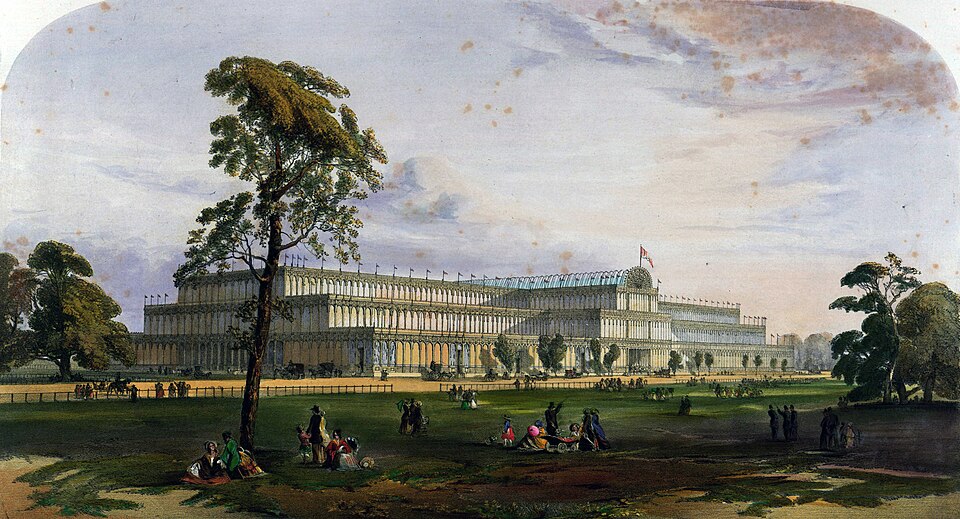
Meanwhile, the French were putting on exhibitions that were bigger and better. Albert and Henry Cole, assistant keeper at the Public Records, decided to develop the Society’s events on a far grander scale, to rival the French. A Royal Commission was established in January 1850 to plan ‘A great Exhibition of the Works of Industry of All Nations.’ Members of the Commission included Robert Stevenson and Cole.

Sir Joseph Paxton designed the Crystal Palace. It was a cast-iron and plate-glass structure located in Hyde Park. The building was 1,851 ft (564m) long with an interior height of 128 ft (39m). The building was 990,000 ft (92,000 m²) with 293,00 panes of glass, and its iron structure was manufactured by Chance Brothers.
The prefabricated building was completed in 39 weeks and housed more than 14,000 exhibitors from around the world between 1st May and 15th October 1851. The Crystal Palace astonished visitors by its size and lighted by natural daylight, and hailed a great success as it showcased the achievements of British industry and technology and had global appeal, fostering a global market and enhancing Britain as a leader in industry. It influenced the design and concept of future world fairs.
In 1854, the Crystal Palace was relocated to Sydenham Hill, where it hosted 14,000 worldwide projects and established global markets for British industrialists. It inspired future exhibitions and laid groundwork for future world’s fairs and exhibitions, influencing the design and concepts of such events.
At Sydenham Hill it was rebuilt and expanded with extensive gardens and attractions, becoming a popular leisure destination and hosting various events: concerts, exhibitions and even the first recorded Crystal Palace football team.


During World War 1, in December 1914, a short article appeared in the local paper. The Admiralty took the palace over as a naval training facility:
- Extensive alterations and additions will be made in order to provide training quarters for at least 10,000 men.
- These works will be put in hand at once and will necessitate the total exclusion on and after the end of December.
It was officially named HMS Victory VI, but was more commonly known as HMS Crystal Palace. The Crystal Palace went up in flames in 1936. My mother, living in West Wickham, witnessed the fire, as I am sure many local people did. It was never to be rebuilt, though the grounds have been used for sporting events; swimming and athletics, and concerts.
Originally published in Life in Bromley magazine (July 2026)