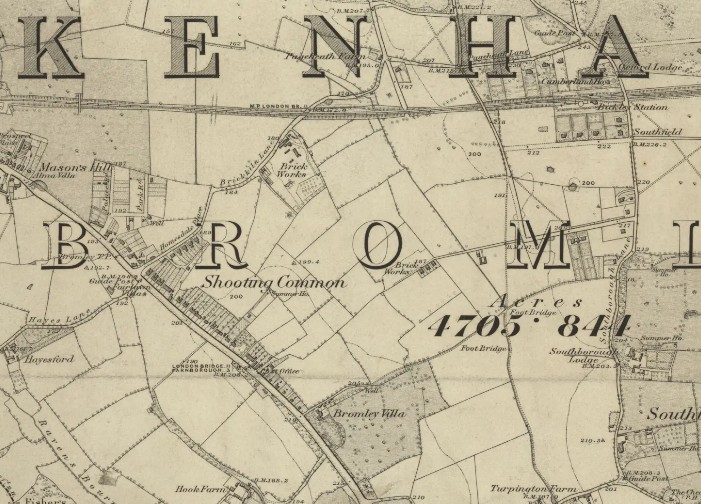
Looking at the earlier maps available – surveyed 1862-1868 I noticed the name Brick Kiln Lane as part of Homesdale Road, near the railway bridge. Here were the brickworks off Waldo Lane; a little lane of terraced houses for the labourers
The brick fields have now been replaced by the Broley recycling centre and industrial hub. The problem with researching brick fields is the lack of a paper trail. It has not been possible to find out when it was first opened to make bricks. Brick taxes on the production of bricks were charged in 1784-1850.
The first mention of Brick Kiln Lane in the Rate Books was for Bromley in January 1853. It was owned by Coles Child of Widmore.
In the decade after 1861 Bromley was growing. It increased from 1864 and has continued ever since.
Brick Kiln Lane, Bromley
Workers Houses on Waldo Road, Bromley [photo c. 1975] (c) Ideal Homes
During the decade 1851-1861 the railways became actively operational in the Bromley district. In July 1858 the Mid Kent Railway company opened Bromley South to St Mary Cray. In 1860 the East Kent Railway Company connected their system with existing lines. Finally, in November 1861 all the lines were amalgamated. As transport improved, so did the population. Bricks would be needed to construct both houses and railways: the cuttings, bridges and embankments.
Bromley lies on clay. It is evident when we dig in our gardens. In prolonged dry weather, it is rock solid and during wet weather; claggy. The area around the brickworks is particularly rich in London Clay; perfect for making London Stock Bricks in the building of small, terraced houses for local workers to keep the supply of labourers available and the development of housing around Chatterton Road.
It is estimated that it would take 10,000 bricks to build each house. I have estimated the area of the brickworks at about 20 acres (8 hectares) in the Waldo Road area and behind Homesdale Roads and the output might have been between 50 and 160 million bricks, bug ti a depth of about 4 feet.
It was not the only brickworks in the area. To the north was a brick field on Tyley Road and another in what is now Southlands Road, where six terraced houses are shown on the map. These two brickfields would have been on a smaller scale than the Waldo Road site and for a specific purpose: the six semi-detached houses in Southlands Road and perhaps a grander house in Widmore.
For many years the brickworks were owned by the Landowner, Coles Child.
In the 1911 census, living at 162 Homesdales Road, James John Peill’s occupation was given as Manager of the Brickworks. In 28 Chatterton Road, Charles and Chas Greenaway were bricklayers, while Robert Cauch (?) was a bricklayer’s labourer.
We know that the brickfields tended to be worked by family gangs, comprising six to eight men, women, boys and girls. The two most highly skilled artisans; the ‘moulder’ who would make the bricks and the clamp-setter who was in charge of baking the bricks.
Kent XVI - OS Six-Inch Map
Former site of Gasworks (now Tesco) Photo: Google Maps
The raw materials: clay, ash and dust were brought to him, and the moulded bricks were taken away for drying by his gang. It was seasonal work and long hours for all. Parliamentary enquiries into the conditions of work for women and children eventually brought change, but it was slow to reach the statute books.
The gasworks (site of Tesco) was built between 1868-1894. Coal was burned to create the gas. The by-products- ash and dust, were valuable ingredients for making bricks. The area must have been a thriving community with employment in the gasworks, laundry, a pub and a row of small terraced houses for labourers, and local shops.
Gradually, the brickworks disappeared from the records and maps, taken over by Bromley Borough Dept. The final reference to the brickworks was in 1932.
With thanks to Peter Hounsell and his book “Bricks of Victorian London.
Originally published in Life in Bromleymagazine (August 2026)